A Thin Membrane
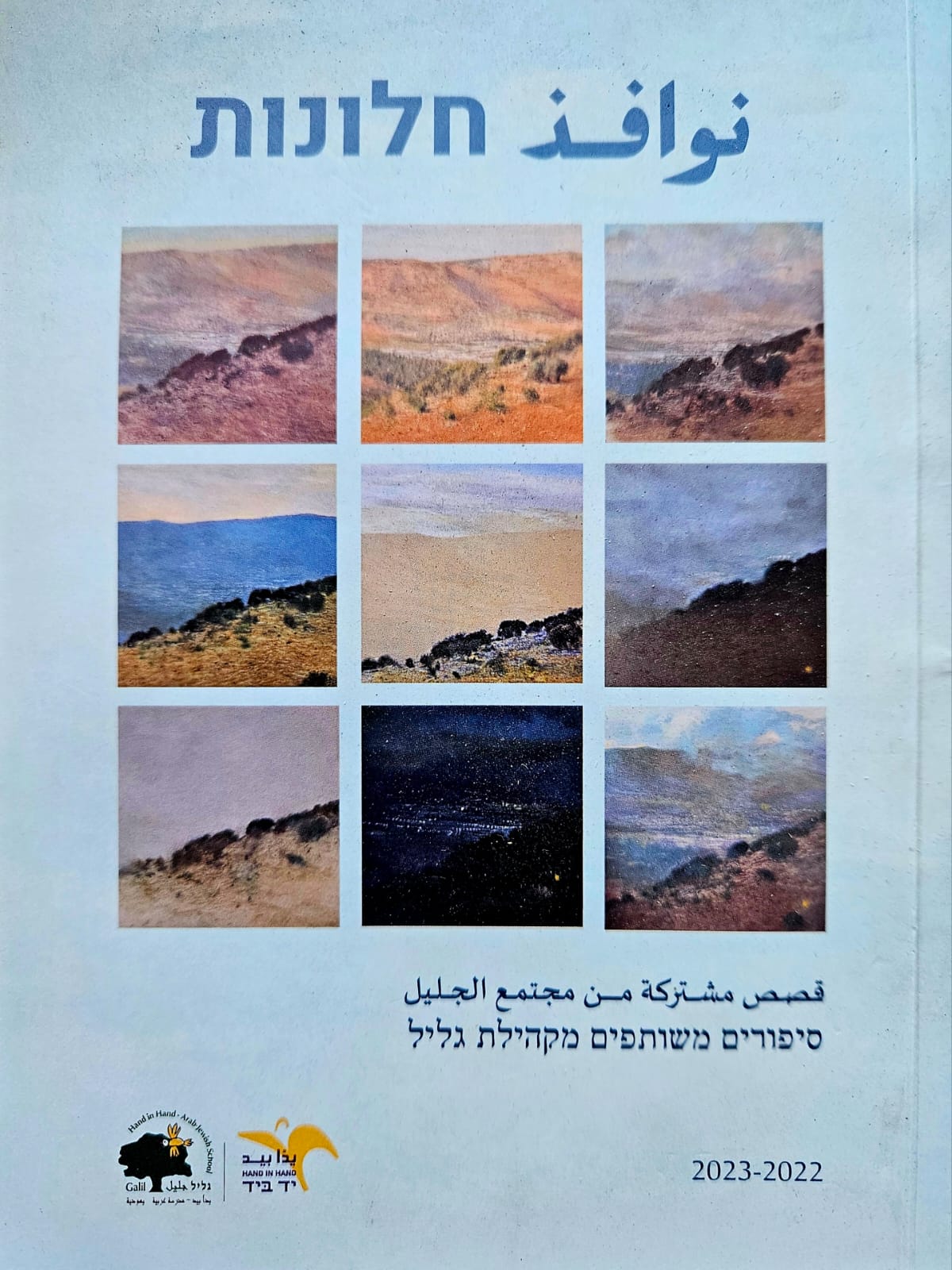 A Thin Membrane is a short story that I wrote while participating in a creative writing workshop at the Galilee School near my home. There were about twenty Jewish and Arab participants in the workshop, which was led by writer and translator Eyad Barghuthy, and ended in the summer of 2023. “Windows” was chosen as a common theme for the stories written by participants, and published in an Arabic-Hebrew booklet. The booklet’s cover featured nine parts of my painting series “Sixteen Views of the Same Hillside.” However, I’m not presenting my story here because of the cover paintings, but rather because my paintings and their connection to memory play a central role in it. In the booklet, the story appears only as text – here, I’ve added images of paintings.
A Thin Membrane
Paper, glass, a plastic bag – thin and delicate membranes. The paper is opaque, the glass transparent, and the bag is right in between – semi-transparent and semi-opaque. The transparent window is actually the thickest of the three, but also the most fragile. On paper appear written memories, thoughts, and feelings; and people used to write letters to one another on it. Glass separates outside from inside. A plastic bag holds things inside. And what about a painted canvas?
All of these materials participate in the story that follows. Some fit together, like a letter inside an envelope inside a bag. And some cannot be easily attached or glued, like fragments of a broken window.
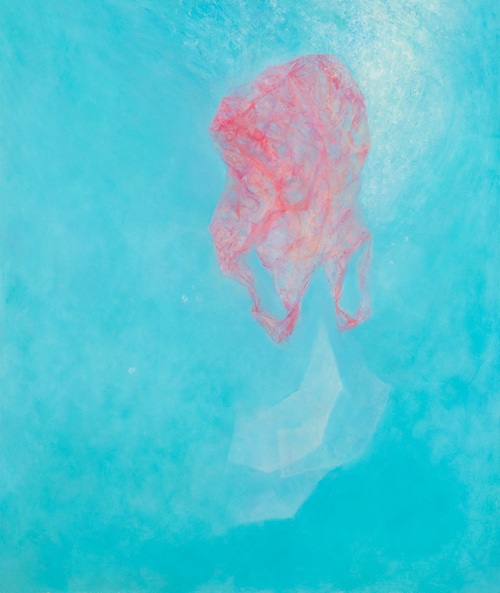
Detail from Lost and Found, 2015, oil on canvas
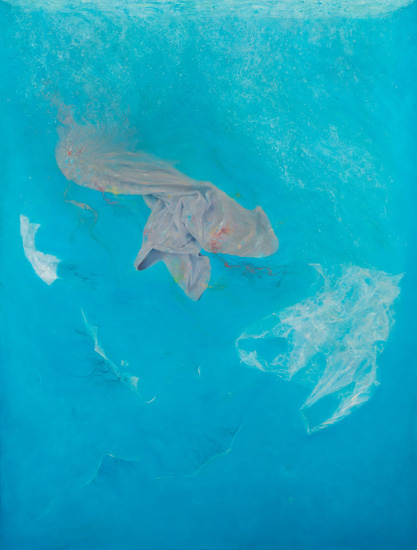
Dance, 2017, oil on canvas, 125 X 95 cm (49″ X 37″)
Exhibition
An art gallery, paintings on the wall, people sitting in a circle and talking with the painter about her works. The painter asks them what they see in one of the paintings. It has a rounded shape in a fiery pink color, but appears transparent, full of folds and wrinkles. The amorphous shape is underwater, with delicate shapes of white papers, barely visible, pouring out of it. The water is painted in intense turquoise shades, with brushstrokes creating a kind of whirlpool of white bubbles. One woman suggests that the pink object is a bodily organ, perhaps a womb, perhaps lungs, and another suggests that it’s a woman’s swimsuit. The painter tells them that it is a simple plastic bag from the supermarket, a lost bag that contained letters from her mother. It turns out that in a certain light, even a cheap bag looks like a glowing gem, and she found herself painting its complex form over and over. In another painting, the bag (this time in transparent-white) is again underwater, next to the painter’s work shirt, which inflates underwater as if with a pregnant belly. The paint stains from the shirt along with the ink from the letters melt into the water, become erased. “But rather than being sad, the shirt and the bag look to me as if they are dancing together, a dance of creation and obliteration,” explains the painter. And then she points to a triptych, the three paintings hanging opposite, “Since the loss of the bag of letters, I’ve imagined it in all sorts of places. In each of the three paintings, the bag is in a different place: in the water, in the earth, and in the air, flying.” Someone asks: “What about fire?”
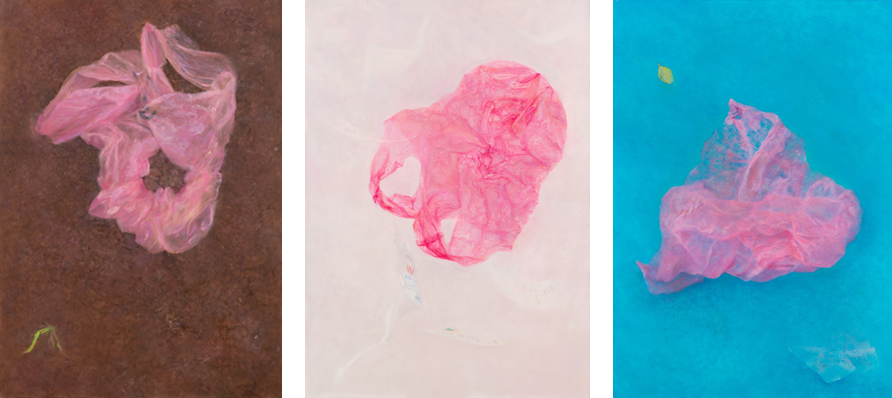
Earth, Air, Water, 2017, oil on canvas, 70 X 50 cm (28” X 20”) each
Airmail Letters
Eight years have passed since the letters disappeared. Before that, I read them every year, on my mother’s yahrzeit. Old, creased papers, inside envelopes with various addresses, from different places where I lived: in the kibbutz, in the university dorms in Jerusalem, or in a military teachers’ apartment in Beersheba. The sender’s address, written on the side or back, was my childhood home in Washington. Among the letters were many light blue airmail letters, that fold into themselves and form a letter and an envelope in one. Most of the letters were typed on a typewriter, and those that weren’t were written in an almost illegible handwriting (which explains why the others were typed). And what was written in them? I remember that every letter was like a collage of words of love and longing – longing for me and longing for Israel – alongside family stories, anecdotes from my mother’s work for a congressman, and comments on the political situation in the United States and Israel, always framed by strong opinions. All these topics were jumbled together, without any clear order. She hardly ever mentioned the illness. Isolated paragraphs come to mind. For example: “The Reagan government says tax breaks for the rich will cause growth and benefit everyone, but it never really reaches the poor”; “Passover Seder was great, but what are we doing here? In Jerusalem, I felt the holiday in the streets, with cleaning and with the burning of chametz in the yards. Here at the supermarket there’s just a pathetic shelf with a ‘Passover products’ label. We missed you, with your caring and your subtle sense of humor.” “Begin says they’re going to thicken the settlements. His brain is thickening! Uncle S. went to China!” When my mother’s friends meet me, I see tears in their eyes, because my face so resembles hers. But from the memories, and from the memories of the letters, I am more and more aware of the difference between us. I see everything from multiple perspectives; I work alone in the studio, painting thin and delicate transitions. She was outgoing, funny, enlivening her surroundings, and, in a rare moment, furious enough to break a window.
Sometimes I think it happened for a reason. I needed to lose those letters in order to distance myself, to separate.
Two Broken Windows
I saw how scared she was – a thin, shy, and smart girl, about seven years old. We were in a large department store looking for new clothes for the new school year. She wanted a simple, dark blue cardigan sweater. It was hard to find one. All of a sudden, there was a commotion followed by a huge noise, a crash, and then the sound of glass falling on the asphalt outside. In a flash, we saw a skinny blonde teenager running through the store, and a policeman or guard in uniform running after him. The teenager went through a huge glass pane, which shattered into pieces. Actually, it was the entrance door to the store, which continued in a straight line with the display windows that surround the entire building, drawing customers in with chalk-white, featureless mannequins dressed in the latest fashion. It all happened so fast – the running teenager was caught outside the store. They handcuffed him and took him away in an ambulance. She was in shock. “Why did that happen? Why did he run like that? Will he die from the glass wounds?” On the drive home in our car, the questions continued: “Did he steal something from the store? Why? Did he come from a home where there’s no money for food? So maybe it’s not his fault that he stole, maybe he had no choice.” I’m proud of the questions she asks, but I worry that she’s so sensitive. I feel how she’s starting to take the weight of guilt onto her slim, delicate shoulders, asking herself why she has while that boy doesn’t. How can I strengthen her? How can I explain to her that a person has a choice, that one can rise from poverty without breaking the law? But is that always the case? I want to tell her the truth. Through a shattered display window, my young daughter discovered how broken our world is.
But there was another broken window, smaller, with a quieter crash. Which window broke first? I no longer remember.
In our kitchen, everyone sat around the white round table and ate dinner: meat, potatoes, lettuce salad. I hate to cook, and found the fastest and simplest recipes. Why did I react like that? Why did I lose my temper? Girls fight; sisters fight. I saw her holding a knife near her sister’s neck – I know it wasn’t serious, and the knife wasn’t sharp. But the day had been so long, and the three of them wouldn’t stop pestering each other over silly things. “I hate you,” they said to each other. This morning, I taught young people coming to university for the first time, training them as paraprofessionals to work with families at risk in their neighborhoods. It was amazing, I felt the beginning of change happening. I told them that even though I look different from them – I’m a white Jewish woman, with a family and a big house – maybe they’d be surprised to hear that my mother started working in a sewing factory at age 14. I’m a first-generation college student; they can be too. In the afternoon, they came to interview me about the program for the newspaper. The headline will be “Recruits Train for War Against Poverty.” I came home excited and happy, but also so tired. I wanted to talk about my experiences, but instead I was met by household chores: food, dishes. And instead of thanks, instead of asking how my first day at the new job was, the entire mealtime was made up of complaints and bickering. Shouting, “Enough! I can’t take it anymore!”, I hit the old exit door, without my even noticing that the blow landed not on the wooden door but on the window inside it. The glass broke. A shout, a sound of a crash and breaking, and then a great silence. He might have been more shocked than the girls. He never gets angry like that. But the girls were also stunned, my wild anger definitely frightened them. They are allowed to shout and argue, I am not.
Raw emotion hides beneath the thin membrane of our self-control and manners, threatening at any moment to break through it, to explode into fragments – like a broken window.
Memorial
The daughter is now four years older than her mother, that is from her age when her mother died. She feels the need to mark the memorial this year in a special way, because 35 years have passed. A significant period of time. She organizes a Zoom call with extended family and friends. She shows them old video clips from a program on democracy at the Hebrew University. In one clip, her mother tries to speak a little Arabic with the young participants from East Jerusalem. The daughter remembers how she and her sisters were embarrassed the first time it was screened, in the first year of mourning, because her mother tried to say she was from America, but it came out as “Ana fi America” (I’m in America). But now she is no longer embarrassed.
On the day of the yahrzeit the immediate family meets at the cemetery in Jerusalem. They read chapters of Psalms and the daughter plays an old recording where Lavana, the social worker from Jaffa, tells how her mother changed her life. She finds herself losing patience with all these stories. Enough already! How many lives can one person change? Now they are sitting in the young couple’s living room. The rustle of teacups and spoons, the smell of butter cookies, chatter. Her older sister sits opposite her, telling her about something that happened at work. She resembles her but is thinner, and with dyed hair – you can’t guess that she’s the oldest. Suddenly she pulls out a transparent bag and says casually, “This was at my house, take it.” The younger sister sees them: thin, faded airmail letters, light blue. She pulls one out and immediately recognizes the words, about the Camp David talks between Begin and Sadat, about longing. The blood drains from her face, and she immediately covers it with her hands. “What happened?” Everyone is worried. And in a choked voice she replies: “I don’t believe it – these are the letters I lost! How did you get them?” “But these can’t be those letters!” her sister replies, “That’s not the color of the bag in your paintings!”
Burning Chametz
Passover eve. The letters have been with me for almost four months. I’ve barely looked at them. Outside, they are burning the chametz, the superfluous, to start a new year, a clean start at springtime. Despite the surprising rain, the flames are big. I go out to see it, the bag of letters in my hands. I hesitate: should I throw them into the fire? Perhaps it’s enough just to imagine it, to paint it, or to write a story about it. Without peeking, I reach into the bag and pull out one letter. The date is June 7, 1981. I turn it over to read the final paragraph: “Missing you is like a regular, constant experience; your face appears at odd times all during the day, thoughts of you intrude into seemingly irrelevant events. I do want to see you soon.” And then a handwritten addition: “I’d vote for Rubenstein or Labor if I had the chance.”
Afterword and Afterimage (written in 2025)
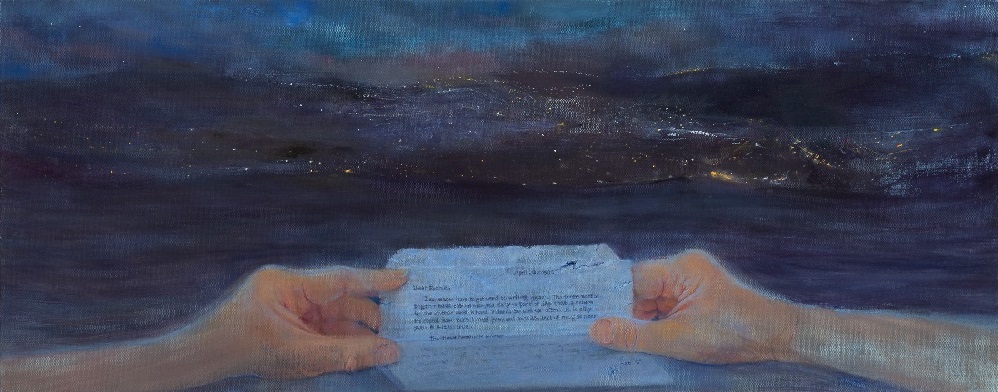
Air Letter, 2023, oil on canvas, 38×96 cm (15×38 in)
This last painting was created parallel to the writing of this story, as a way of closing the chapter that began with the loss of the letters from my mother, and the paintings that related to that loss (you may view more of them here).
And no, I didn’t burn the letters.